
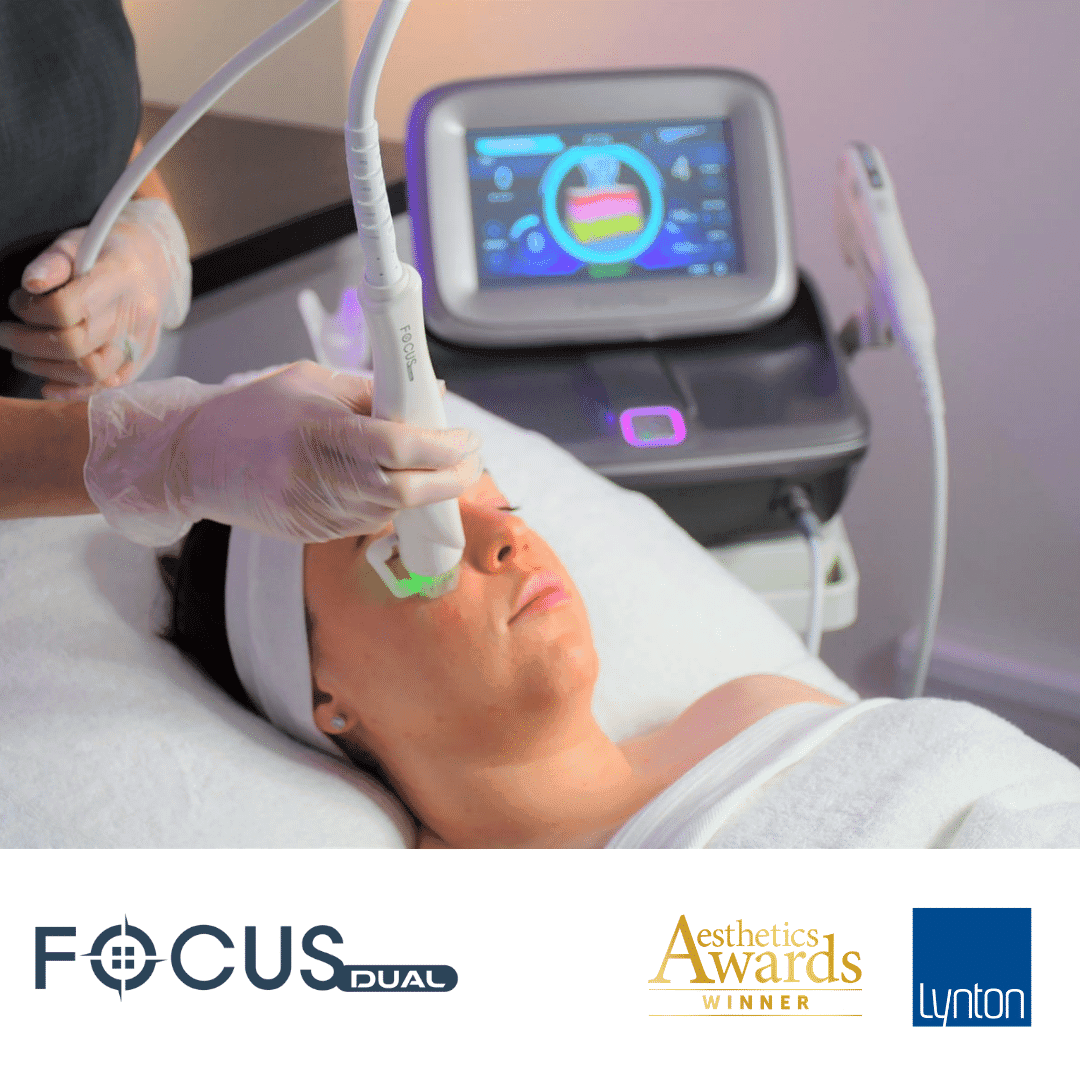
RF Microneedling in Hounslow
RF microneedling — radiofrequency microneedling — is a step up from standard microneedling. Instead of relying on needle punctures alone, it uses insulated needles to carry radiofrequency energy to a controlled depth inside the dermis, where the heat drives a stronger, deeper collagen-remodelling response than needling can achieve by itself. At Skin Health Practice in Hounslow, we deliver RF microneedling on the Lynton Focus Dual, the same platform we use for HIFU, which lets us set needle depth and energy precisely for the skin in front of us. It is the treatment we most often turn to for deeper atrophic acne scarring, mild-to-moderate skin laxity, enlarged pores and stubborn texture. It is not an instant fix and it is not a facelift: results build gradually over months across a course of sessions, and the honest goal is meaningful improvement rather than erasure. If you are still weighing up your options, our microneedling page covers standard collagen induction therapy in full — this page is about when adding radiofrequency is worth it.
Reviewed by Su Rixon · Aesthetic Clinician · Last reviewed April 2026
How RF Microneedling Works
RF microneedling begins the same way as standard microneedling: an array of ultra-fine needles creates controlled micro-injuries in the skin, triggering the body's natural wound-healing cascade and prompting new collagen and elastin. Our microneedling page explains that mechanism in detail. What radiofrequency adds is heat, placed exactly where it is useful. Once the needles reach their set depth, radiofrequency energy passes between them and warms the surrounding dermal tissue to a target temperature. Two things follow. First, existing collagen fibres contract in response to the heat, producing a subtle immediate firming. Second — and this is the point of the treatment — the controlled thermal injury sets off a much more substantial remodelling response, with the body laying down fresh collagen and elastin around each treated column over the following weeks and months. Because the energy is concentrated at depth rather than at the surface, the outer layer of skin is largely spared, which is why a treatment that works considerably deeper than needling alone still recovers in a couple of days rather than a fortnight.
RF Microneedling vs Standard Microneedling
This is the question we are asked most often, and the honest answer is that neither is universally better — they do different jobs. Standard microneedling is purely mechanical. It creates micro-channels, stimulates collagen, and allows serums to penetrate deeper, and it is excellent for overall skin quality, fine lines, mild scarring and texture. It is also gentler, cheaper per session, and has a very low risk profile. RF microneedling adds thermal energy in the dermis, which produces a stronger tightening and remodelling effect and reaches concerns that needling alone tends to under-treat: deeper boxcar and rolling acne scars, established laxity, and pores that have not responded to a course of standard needling. The trade-off is that it is a more aggressive treatment — slightly more discomfort, a little more swelling, and settings that need more care, particularly in darker skin. In practice, we recommend standard microneedling when the concern is skin quality and mild texture, and RF microneedling when there is real depth to the problem or a tightening component to address. Many clients use both over time. Because both are available in the clinic, we are not obliged to fit your skin to one machine.
RF Microneedling for Acne Scars
Atrophic acne scars — boxcar, rolling and, to a lesser extent, ice-pick scars — are depressions left where inflammation destroyed collagen and the skin healed with too little to fill the gap. Treating them means rebuilding collagen underneath the depression and releasing the fibrous tethers that pull rolling scars downwards. RF microneedling suits this well because the needles can be set to the depth of the scar and the radiofrequency energy remodels tissue exactly there, rather than only at the surface. Rolling and boxcar scars generally respond best; narrow, deep ice-pick scars are the hardest scar type to treat with any modality and often need a combined approach. Realistically, most clients see progressive softening and shallowing of scars across a course of four to six sessions, with improvement continuing for months afterwards as collagen matures. Scars become less noticeable rather than invisible — anyone promising complete removal is overselling. If active breakouts are still occurring, we treat the acne first, since scarring a moving target rarely works. Our acne scar treatment page sets out the full range of options and how we combine them.
What Else RF Microneedling Treats
Beyond acne scarring, RF microneedling is one of our main tools for mild-to-moderate skin laxity — the crepey, thinning quality that develops with age along the jawline, cheeks, neck and décolletage. It works within the dermis to firm the skin's surface and mid-layers, which complements HIFU rather than competing with it; HIFU reaches the deeper SMAS layer for structural lifting, and the two are often planned together. Enlarged pores respond well, as new collagen laid down around the pore wall tightens its appearance over a course — see our large pores page for how we approach that specifically. RF microneedling also softens fine lines, improves general roughness and uneven texture, and can be used on surgical scars and stretch marks. It can be performed on the face, neck, décolletage and body. What it does not do is remove deep static wrinkles, replace lost facial volume, or lift significant sagging — for that, our skin tightening page explains where non-surgical treatment genuinely helps and where it does not.
Delivered on the Lynton Focus Dual
Our RF microneedling runs on the Lynton Focus Dual, a platform from British aesthetics manufacturer Lynton that houses both HIFU and radiofrequency microneedling in a single system. For RF microneedling, what matters is control: the practitioner sets the needle depth, the energy level and the duration of the pulse, and can vary all three across different areas of the same face. Shallower, lower-energy settings are used on thin, delicate skin; deeper settings on scarred cheeks or a lax jawline. Sterile, single-use needle cartridges are used for every client. The practical advantage of the Focus Dual is planning — because HIFU and RF microneedling sit in the same device, we can address deep structural laxity and surface remodelling within one coordinated course rather than sending you elsewhere for half the answer. Our Focus Dual treatment page explains how the two modalities work together.
Who RF Microneedling Suits — and Who It Doesn't
RF microneedling suits adults with atrophic acne scarring, mild-to-moderate skin laxity, enlarged pores, uneven texture or early fine lines, who are willing to commit to a course and wait months for the full result. It suits people who have tried standard microneedling and want to go further. Because radiofrequency heats tissue rather than targeting pigment, it can be used across a wide range of skin tones when settings are appropriate — but this needs saying carefully. Melanin-rich skin is more reactive to thermal injury, so in Fitzpatrick IV–VI we treat conservatively: lower energy, fewer passes, longer intervals between sessions, and a patch test first. The risk to manage is post-inflammatory hyperpigmentation, and it is real; strict sun avoidance and daily SPF before and after treatment materially reduce it. Given our Hounslow catchment, we treat South Asian skin routinely and plan accordingly. RF microneedling is not appropriate during pregnancy or breastfeeding, over active acne, infection or eczema in the treatment area, for anyone with a pacemaker or implanted electronic device, with metal implants in the treatment area, with a history of keloid scarring, on recently tanned skin, or within six months of oral isotretinoin (Roaccutane). Certain medications and skin conditions also need review. All of this is what the consultation is for, and if RF microneedling is the wrong treatment for you, we will say so.
The Session, Downtime and Aftercare
A topical anaesthetic cream is applied 30 to 45 minutes beforehand. The treatment itself takes roughly 30 to 45 minutes for a full face and feels like a series of firm pressure points with a distinct sensation of heat — more noticeable than standard microneedling, but well tolerated under numbing cream. Bony areas such as the forehead and jawline tend to be the most sensitive. Immediately afterwards the skin is red, warm and tight, similar to sunburn, and some swelling on the following morning is normal. Redness typically settles over one to three days; you may see a faint grid pattern from the needle array for a day or two. Most people return to work the next day. Afterwards: no makeup for 24 hours, no active skincare — retinoids, acids, vitamin C — for 48 hours, and no saunas, steam, hot yoga or intense exercise for 48 hours. Use a bland moisturiser and SPF 50 daily, and be strict about sun avoidance for the whole course, especially if you have deeper skin. Do not pick at any dryness or flaking.
Sessions, Results and What to Expect
RF microneedling is a course treatment, not a one-off. For skin quality, pores and fine lines, three to four sessions spaced four to six weeks apart is typical. For established acne scarring or laxity, most clients need four to six, and deeper or older scarring sometimes more. The pattern of results matters: you will see very little in the first fortnight, some texture and tone improvement from around six weeks, and the substantial change between three and six months after the final session, as new collagen matures. This is slow, cumulative work — which is exactly why it lasts. Results are long-lasting but not permanent; the skin continues to age, so occasional maintenance sessions help preserve what you have gained. Outcomes vary with age, skin quality, the depth of scarring and factors like sun exposure and smoking, and we will not quote you a percentage improvement we cannot stand behind. At your consultation we assess your skin, tell you how many sessions we realistically think you need, and set out what we do and do not expect to achieve. Skin Health Practice is a specialist skin and laser clinic in Hounslow, West London, seeing clients from Isleworth, Twickenham, Brentford, Ealing, Southall and Feltham. Your initial consultation is free.
Have Questions?
Our team is here to help you find the right treatment.
Why Choose This Treatment
Key Benefits
Reaches deeper than standard
Reaches deeper than standard microneedling by delivering RF energy inside the dermis
One of our most
One of our most effective options for atrophic boxcar and rolling acne scars
Firms mild
Firms mild-to-moderate skin laxity and refines enlarged pores over a course
Needle depth and energy
Needle depth and energy set precisely on the Lynton Focus Dual for your skin
Suitable across a wide
Suitable across a wide range of skin tones with conservative, patch-tested settings
Short recovery
Short recovery — redness typically settles within one to three days
Results build gradually over
Results build gradually over three to six months as new collagen matures
Frequently Asked Questions
Have Additional Questions?
Get in touch and our team will be happy to help.
You May Also Be Interested In
Related Treatments
Further reading & safety information
Independent, non-promotional guidance from UK health and professional bodies:
Talk to Us About RF Microneedling
Book a free consultation at Skin Health Practice in Hounslow. We'll assess your scarring, laxity or texture honestly and tell you whether RF microneedling — or something else — is the right treatment for your skin.