
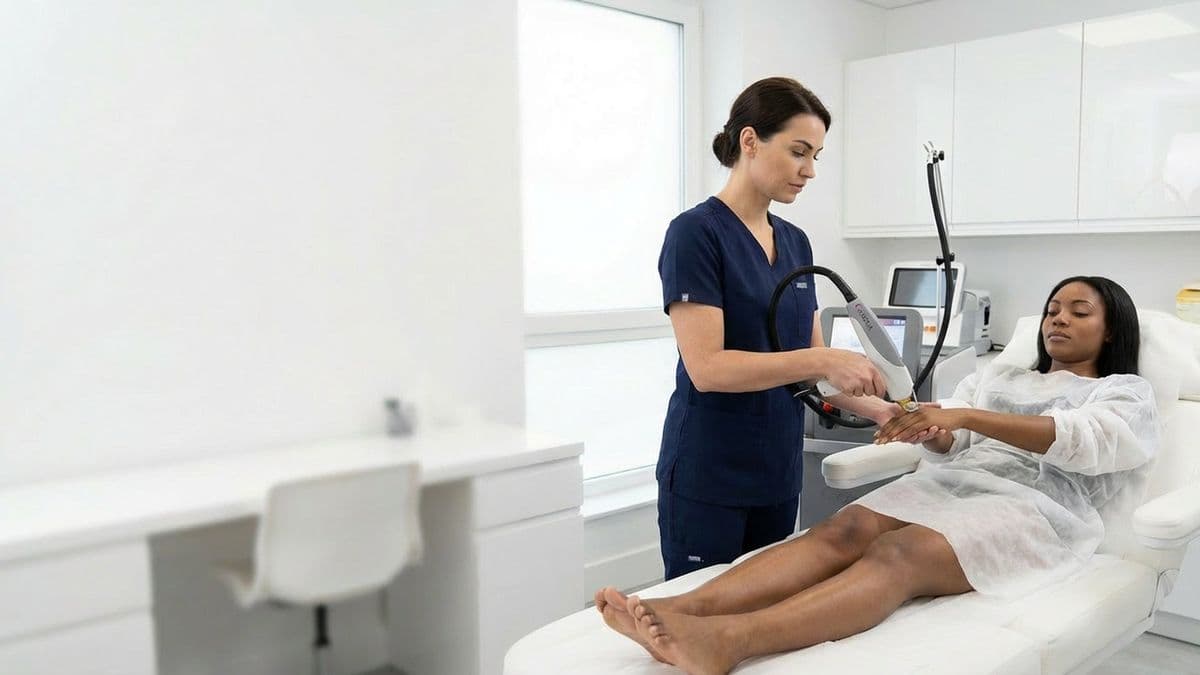
Laser Hair Removal for Dark Skin in Hounslow
Laser hair removal has a long history of being unsafe — or simply refused — for people with very dark skin. On Fitzpatrick V and VI skin, the wrong laser can cause burns, blistering and long-lasting pigmentation change, so many Black and Afro-Caribbean clients have been told outright that they are 'not suitable' for laser. That advice is outdated. At Skin Health Practice in Hounslow, we treat the deepest skin tones using the Nd:YAG 1064nm laser — the wavelength backed by dermatological evidence as the safest option for high-melanin skin — combined with careful patch testing, conservative settings and practitioners experienced in skin of colour. This page focuses on the safety science that matters specifically for dark skin. For a general explanation of how laser hair removal works, see our main laser hair removal page.
Reviewed by Su Rixon · Aesthetic Clinician · Last reviewed April 2026
Is Laser Hair Removal Safe for Dark Skin?
Yes — provided the correct laser and settings are used by someone experienced in treating skin of colour. The safety issue with dark skin has never been the concept of laser hair removal itself; it is the type of device. Laser and IPL systems work by targeting melanin, and very dark skin (Fitzpatrick V–VI) contains a large amount of melanin in the epidermis as well as in the hair. If the device cannot tell the difference between skin pigment and hair pigment, that energy is absorbed by the skin surface, causing heat injury. The Nd:YAG 1064nm laser solves this problem by using a much longer wavelength that is only weakly absorbed by surface melanin, so it can reach the follicle without overheating the skin above it. This is why, at a properly equipped clinic, laser hair removal on Black and very dark skin can be both safe and genuinely effective.
Why the Nd:YAG 1064nm Wavelength Is Right for Fitzpatrick V–VI
The wavelength of a laser determines how deeply it travels and how strongly it is absorbed by melanin. Shorter wavelengths (such as the 755nm Alexandrite) are absorbed very strongly by melanin — excellent for pale skin with dark hair, but hazardous on high-melanin skin because the epidermis absorbs too much of the energy. The Nd:YAG operates at 1064nm, near the far end of the useful range. At this wavelength, absorption by epidermal melanin drops dramatically while the beam still penetrates deep enough to reach the base of the follicle, where it heats the pigment and the surrounding structures that regenerate hair. In practice this means the Nd:YAG can bypass the melanin in dark skin and act selectively on the follicle — the exact property you need for Fitzpatrick V and VI. It is widely regarded in dermatology as the laser of choice, and the safest option, for the darkest skin tones.
Why IPL, Alexandrite and Some Diode Lasers Are Risky on Dark Skin
Understanding what to avoid is as important as knowing what to choose. IPL (intense pulsed light) is not a true laser but a broad spectrum of light; because it is unfocused and includes shorter wavelengths that melanin absorbs strongly, it carries a high risk of burns and pigmentation change on dark skin, and many salon IPL machines are simply not designed for Fitzpatrick V–VI at all. The 755nm Alexandrite laser is superb for lighter skin but is generally considered unsuitable for the deepest skin tones for the same reason — too much of its energy is taken up by epidermal melanin. Older or lower-specification diode lasers (around 800–810nm) sit in between: some modern diode systems can be used cautiously on darker skin with heavy cooling and low settings, but the margin for error is narrower than with the Nd:YAG. When a device absorbs energy at the skin surface rather than at the follicle, the result can be a burn, a blister, or — most commonly on dark skin — post-inflammatory hyperpigmentation. For Fitzpatrick V and VI, the Nd:YAG remains the clear evidence-based choice.
Post-Inflammatory Hyperpigmentation (PIH) — and How We Minimise It
PIH is the single most important risk to understand for dark skin. It is a darkening of the skin that appears after inflammation or heat injury — the skin responds to the insult by producing extra pigment, leaving darker patches that can take weeks or months to fade. Dark skin is more prone to PIH than lighter skin, which is precisely why laser choice and technique matter so much here. We reduce this risk at every stage: by using the Nd:YAG wavelength that spares the epidermis; by carrying out a patch test before any full session so we can see how your skin responds before treating a large area; by starting at conservative energy settings and increasing only gradually as your skin tolerates it; by using surface cooling to protect the epidermis during each pulse; and by insisting on strict sun avoidance and daily SPF before and after treatment, because tanned or sun-exposed skin raises the PIH risk considerably. No treatment can promise a zero risk of pigmentation change, but a correctly chosen laser in experienced hands makes it uncommon.
Are You a Good Candidate? Suitability and Assessment
Suitability for laser hair removal on dark skin depends on more than skin tone alone. At your consultation we assess your Fitzpatrick type, your hair colour and coarseness, the area you want treated, your medical history, any medications that affect light sensitivity (such as certain antibiotics and retinoids), and any history of keloid scarring or pigmentation problems. Laser targets pigment in the hair, so it works best on dark hair; grey, white, red or very fine blonde hair contains little pigment and responds poorly regardless of skin tone — this is a limitation of the technology, not of dark skin. If you have recently been in strong sun or used fake tan, we will ask you to wait until your skin returns to its baseline. If you have an active skin condition in the treatment area, we may postpone until it settles. Being honest about expectations at this stage is part of treating you safely.
Realistic Results: Honest Expectations for Dark Skin
Laser hair removal produces long-term hair reduction, not guaranteed permanent removal — and that is true for every skin tone. After a full course, most clients see a substantial, lasting reduction in hair, with whatever regrows tending to be finer, sparser and slower. Because hair grows in cycles and only follicles in their active phase respond, a course of sessions spaced several weeks apart is always needed; the exact number varies with the area, your hair type and any hormonal factors. Coarse, dark hair — common across African and Afro-Caribbean skin types — tends to absorb laser energy well, which is an advantage. However, hormones can drive new hair growth over time (for example with PCOS), so occasional maintenance sessions may be needed to keep results in check. We will never promise 100% or 'permanent' clearance; what we can offer is a realistic plan and a significant, durable improvement for the great majority of clients.
Aftercare and Protecting Your Results
Good aftercare protects both your results and your skin. In the days after each session, keep the area cool and treat it gently: avoid saunas, steam rooms, very hot showers and intense exercise for 24 to 48 hours, and do not pick or scratch any redness or scabbing, as trauma to healing skin is a common trigger for pigmentation change on dark skin. The most important habit is sun protection — apply a broad-spectrum SPF 30 or higher to exposed treated areas every day and avoid deliberate sun exposure and self-tan throughout your course, because UV both increases PIH risk and reduces how safely we can treat you at the next session. You may see treated hairs shedding over the following two to three weeks, which is normal. Shave between sessions if you wish, but do not wax, thread or epilate, as these remove the follicle the laser needs to target.
Specialist Care for Dark Skin in Hounslow and West London
Hounslow is one of London's most ethnically diverse boroughs, and treating skin of colour safely is central to what we do — not an afterthought. Skin Health Practice serves clients across West London, including Hounslow, Southall, Hayes, Feltham, Isleworth, Brentford and Ealing, and we regularly see people who were turned away or badly treated elsewhere because a previous clinic lacked the right equipment or experience for very dark skin. We use medical-grade Nd:YAG technology rather than salon IPL, we patch test every new client, and every course begins with a free, no-obligation consultation so you can ask questions and see how your skin responds before committing. If you have Fitzpatrick V or VI skin and have been told laser 'isn't for you', we would encourage you to get a second opinion.
Have Questions?
Our team is here to help you find the right treatment.
Why Choose This Treatment
Key Benefits
Nd:YAG 1064nm laser
Nd:YAG 1064nm laser — the evidence-based safest wavelength for Fitzpatrick V and VI skin
Long wavelength bypasses surface
Long wavelength bypasses surface melanin, minimising the risk of burns on very dark skin
Low risk of post
Low risk of post-inflammatory hyperpigmentation when treated correctly and conservatively
Patch test and full
Patch test and full skin assessment before any first session
Practitioners genuinely experienced in
Practitioners genuinely experienced in treating Black, African and Afro-Caribbean skin
Works well on the
Works well on the coarse, dark hair common across the deepest skin tones
Also helps reduce ingrown
Also helps reduce ingrown hairs and razor bumps, a frequent problem on dark skin
Frequently Asked Questions
Have Additional Questions?
Get in touch and our team will be happy to help.
You May Also Be Interested In
Related Treatments
Further reading & safety information
Independent, non-promotional guidance from UK health and professional bodies:
Safe, Expert Laser Hair Removal for the Deepest Skin Tones
Your skin type should never rule out smooth, hair-free skin. Book a free consultation and patch test at Skin Health Practice in Hounslow and find out what safe, evidence-based Nd:YAG treatment can do for Fitzpatrick V and VI skin.