
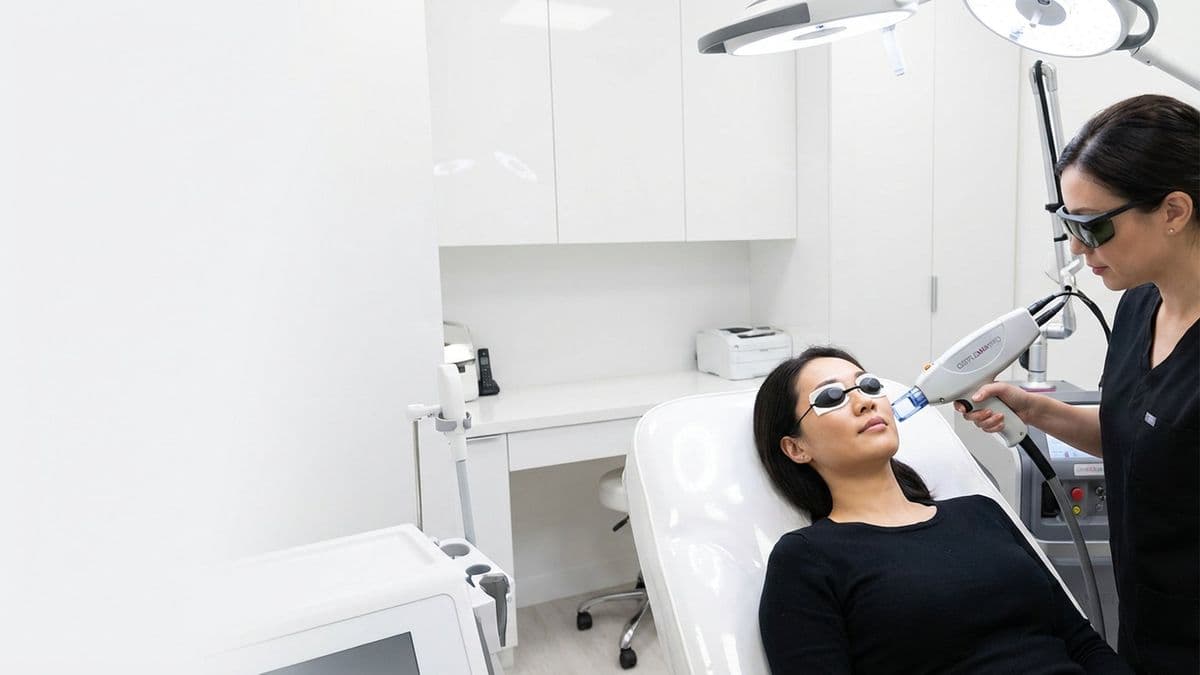
Laser Hair Removal for Asian Skin in Hounslow
Is laser hair removal safe for Asian skin? Yes — when the right laser is used at conservative settings by a practitioner who understands pigment-prone skin. East and Southeast Asian skin (Chinese, Filipino, Vietnamese, Thai, Korean, Japanese and Malaysian heritage) usually sits in the Fitzpatrick III–V range, which means it carries more melanin in the epidermis and is more inclined to react to heat with pigmentation changes. Used carelessly — with aggressive IPL or Alexandrite settings meant for pale skin — laser can trigger post-inflammatory hyperpigmentation (dark patches) rather than clearing hair. Used correctly, laser hair removal for Asian skin is both safe and highly effective at achieving long-term hair reduction. At Skin Health Practice in Hounslow, West London, we take a deliberately conservative approach built around the Nd:YAG 1064nm wavelength, a compulsory test patch, and settings dialled to your individual skin rather than a default. This page focuses specifically on East and Southeast Asian skin; if you are of South Asian (Indian, Pakistani, Bangladeshi, Sri Lankan) heritage or have deeper Fitzpatrick V–VI / Black skin, see our dedicated pages linked below.
Reviewed by Su Rixon · Aesthetic Clinician · Last reviewed April 2026
Why Asian Skin Needs a More Careful Laser Approach
The defining challenge with East and Southeast Asian skin is not the hair — it is the skin's tendency toward pigmentation change. Because the epidermis holds more active melanin than paler European skin, it competes with the hair follicle for the laser's energy. If too much heat is deposited in the skin itself, the melanocytes respond by producing excess pigment, and the result is post-inflammatory hyperpigmentation (PIH): flat brown marks that can linger for weeks or months. Asian skin is genuinely more prone to PIH than lighter skin types, which is why so many people report patchy discolouration after treatment at salons using one-size-fits-all IPL. The goal on Asian skin is to deliver enough energy to disable the follicle while keeping the surface skin cool and calm. That balance is achievable — but it depends on wavelength choice, energy level, pulse duration, cooling and, above all, an experienced eye. Laser hair removal for Asian skin is a discipline of restraint, not power.
Why We Lead With Nd:YAG 1064nm on Asian Skin
The Nd:YAG laser emits a longer 1064nm wavelength that is absorbed far less by surface melanin and penetrates deeper toward the follicle. On pigment-prone Asian skin this is a significant safety advantage: the beam largely bypasses the melanin sitting in the epidermis and delivers its energy where it is needed, at the base of the hair, reducing the risk of burns and PIH. For most East and Southeast Asian clients — particularly medium and deeper tones (Fitzpatrick IV–V) — Nd:YAG is our default. A carefully-set diode laser can also suit lighter Asian skin (Fitzpatrick III) with fine-to-medium hair, provided the parameters are conservative. What we avoid on this skin type is aggressive short-wavelength Alexandrite or high-fluence IPL run at settings designed for pale skin, because shorter wavelengths are much more strongly absorbed by epidermal melanin and raise the risk of pigmentation injury. Wavelength and settings are not interchangeable details here — they are the whole safety story. For the full technical explanation of how laser targets the follicle, see our main laser hair removal page.
The Test Patch and Conservative Settings
Every new client is patch tested before any full treatment — on Asian skin this is non-negotiable rather than a formality. We treat a small, discreet area at conservative settings and then wait to see how your skin behaves over the following days: whether redness settles quickly, whether any pigmentation appears, and how the hair responds. Only once we have confirmed a safe, well-tolerated response do we build a full plan, and even then we begin the first sessions cautiously and step energy up gradually as your skin proves it can handle it. This ladder approach is slower than blasting a high setting from day one, but on pigment-prone skin it is the difference between clean results and months of trying to fade dark marks. If you tan easily, are currently tanned, or have recently had sun exposure, we will delay treatment — tanned skin dramatically increases the risk of a pigmentation reaction.
Fine Versus Coarse Hair — Setting Expectations
Laser works by targeting the pigment in the hair, so the darker and coarser the hair, the more efficiently it absorbs energy and the better it responds. Many East and Southeast Asian clients have exactly this hair type on the underarms, bikini, legs, chin and lip, and those areas typically respond very well. Finer, lighter or downy (vellus) hair — common on the sides of the face, upper cheeks and forearms — holds far less pigment and responds much less predictably; laser cannot reliably treat pale or wispy hair, and we will tell you honestly if an area is unlikely to respond. It is also worth knowing that some naturally darker areas of Asian skin — the bikini line, underarms and knuckles — have a smaller contrast between hair and skin, so those zones need extra care and more conservative settings to protect against pigmentation.
Realistic Results — Long-Term Reduction, Not a Permanent Guarantee
Laser hair removal delivers long-term hair reduction over a course of sessions — it is not a single-session, permanent, 100% solution, and anyone promising that is overselling it. Because hair grows in cycles and only actively-growing follicles absorb enough energy to be disabled, you need a series of treatments to catch each follicle in its active phase. Most East and Southeast Asian clients need around 6 to 8 sessions for body areas and 8 to 10 for facial hair, spaced roughly 4 to 6 weeks apart, though your own number depends on the area, your hair type and any hormonal factors. After a full course, most clients see a substantial, lasting reduction in growth, with whatever regrows tending to be finer and sparser. Some follicles can reactivate over time — particularly where hormones are involved — so occasional maintenance sessions help keep results in check. We would rather set an honest expectation up front than promise permanence we cannot guarantee.
Aftercare and Strict Sun Protection
On pigment-prone Asian skin, aftercare is part of the treatment, not an optional extra — how you look after the skin between sessions has a direct effect on your pigmentation risk. Immediately after each session the area may look slightly pink or feel like mild sunburn; this usually settles within a day or two. For the following 48 hours, avoid heat (saunas, steam rooms, hot showers and intense exercise) and skip exfoliating actives such as retinoids and AHA/BHA acids. The single most important habit is sun protection: apply a broad-spectrum SPF 30 or higher to any treated area that sees daylight, and keep this up throughout your whole course, because UV exposure on freshly-treated skin is one of the biggest triggers of hyperpigmentation. Do not pick or scratch any treated skin, keep the area moisturised with something gentle and fragrance-free, and shave rather than wax or thread between sessions so the follicle stays intact for the next treatment.
Treatment Areas Popular With Asian Clients
We treat any area where unwanted hair is a concern. Among East and Southeast Asian clients the most requested areas tend to be the upper lip and chin, underarms, arms and forearms, bikini line and Brazilian, lower legs and full legs, and — for men — the neckline, chest and back. Facial hair on Asian skin is often finer than on some other groups, so we assess the face carefully and set realistic expectations about which hairs will and won't respond. Naturally darker zones such as the bikini area and underarms are treated with extra-conservative settings. We can build a plan around a single priority area or a full-body course, and we will always talk you through what each area is likely to achieve before you commit.
Why Choose Skin Health Practice in Hounslow?
Hounslow is one of the most diverse boroughs in West London, home to large Chinese, Filipino, Vietnamese, Thai and wider East and Southeast Asian communities, and we have built genuine experience treating this skin type safely. We use medical-grade laser equipment rather than salon IPL, we lead with the Nd:YAG wavelength that suits pigment-prone skin, and every course starts with a proper consultation and a compulsory test patch. If you have previously been turned away, been left with dark marks, or simply been treated with a device set for someone else's skin, we would encourage you to come and talk to us. Your initial consultation is free and there is no obligation to proceed. We serve clients from Hounslow, Isleworth, Brentford, Chiswick, Feltham and across West London.
Have Questions?
Our team is here to help you find the right treatment.
Why Choose This Treatment
Key Benefits
Nd:YAG 1064nm
Nd:YAG 1064nm-led approach — the wavelength best suited to pigment-prone Asian skin
Conservative settings chosen to
Conservative settings chosen to minimise post-inflammatory hyperpigmentation (PIH) risk
Compulsory test patch before
Compulsory test patch before any full treatment on Asian skin
Specialist experience with East
Specialist experience with East and Southeast Asian skin tones (Fitzpatrick III–V)
Medical
Medical-grade lasers — not salon IPL run at pale-skin settings
Honest
Honest, long-term hair reduction — no false promises of permanent or 100% removal
Hounslow clinic serving West
Hounslow clinic serving West London's diverse East and Southeast Asian communities
Frequently Asked Questions
Have Additional Questions?
Get in touch and our team will be happy to help.
You May Also Be Interested In
Related Treatments
Further reading & safety information
Independent, non-promotional guidance from UK health and professional bodies:
Expert, Conservative Laser Hair Removal for Asian Skin
Book your free consultation and test patch at Skin Health Practice in Hounslow. Our specialists will assess your skin tone and hair, explain our Nd:YAG-led approach, and build a careful, personalised plan designed to keep pigmentation risk low.