
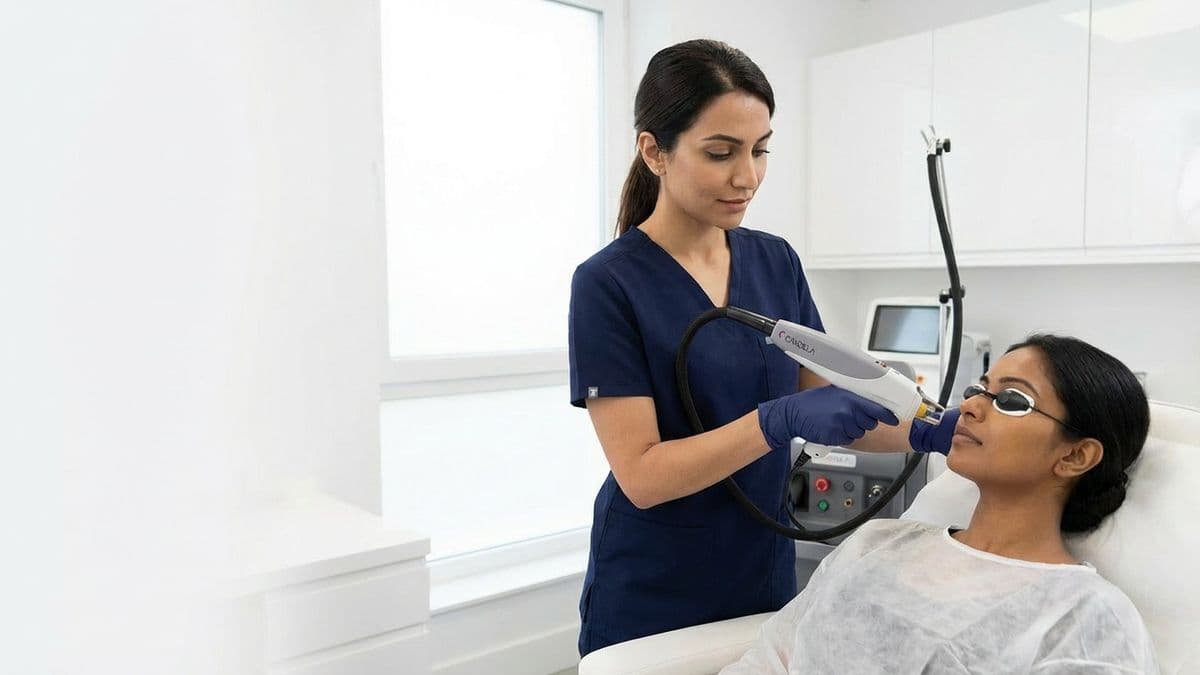
Laser Hair Removal for Indian Skin in Hounslow
Yes — laser hair removal is safe and highly effective for Indian skin, provided the right laser and the right settings are used. Indian and South Asian skin tones (Fitzpatrick types IV–V) are rich in melanin, which is exactly why the wrong device can cause burns or dark marks. The answer is the Nd:YAG 1064nm laser: its long wavelength reaches past the pigment in the skin to heat the hair follicle directly, so it treats coarse, dark South Asian hair extremely well while protecting the surrounding brown skin. At Skin Health Practice in Hounslow — in the heart of West London's South Asian community — we have treated hundreds of clients of Indian, Pakistani, Bangladeshi, Sri Lankan and mixed South Asian heritage, and this is one of our most requested treatments. If you have coarse facial or body hair, or hormonally-driven growth linked to PCOS, this page explains exactly how the treatment works for your skin, how many sessions to expect, and how we keep it safe.
Reviewed by Su Rixon · Aesthetic Clinician · Last reviewed April 2026
Is Laser Hair Removal Safe for Indian and Brown Skin?
This is the single biggest question we hear, and the honest answer is that safety depends almost entirely on which laser is used. Indian and South Asian skin carries more melanin in the epidermis than lighter European skin. Older devices — IPL machines, and the 755nm Alexandrite laser that many salons default to — are strongly absorbed by that surface pigment. On brown skin that means the laser can heat the skin itself rather than just the follicle, which is what leads to burns, blistering and post-inflammatory hyperpigmentation (the dark marks that so many South Asian clients have been left with elsewhere). This is why some clinics simply refuse to treat Indian skin, or worse, treat it with unsuitable equipment. The Nd:YAG 1064nm laser solves the problem: its longer wavelength passes through the epidermal melanin and is absorbed by the follicle deeper down. Used at correctly judged settings by a practitioner who understands skin of colour, it makes laser hair removal genuinely safe for Fitzpatrick IV and V skin. We patch test every new client and start conservatively so we can confirm how your individual skin responds before treating a full area.
Why Nd:YAG Is the Right Laser for South Asian Skin
For the full science of how laser hair removal works, see our main laser hair removal page — in short, the laser targets pigment in the follicle, heats it, and disables its ability to regrow hair. What matters for South Asian skin specifically is the balance between the pigment in your skin and the pigment in the hair. The closer those two are in colour, the more careful the laser has to be. The 1064nm Nd:YAG wavelength is the safest option for brown skin precisely because it is poorly absorbed by epidermal melanin but still reaches the follicle. We pair this with a cooling system that protects the skin surface throughout each pulse. We do not treat Indian skin with IPL, and we reserve the Alexandrite laser only for genuinely light South Asian tones where it is appropriate — the default for Fitzpatrick IV–V is always Nd:YAG. Choosing the right device is not a marketing detail; on melanin-rich skin it is the difference between a safe result and a pigmentation injury.
Coarse, Dark South Asian Hair Responds Extremely Well
There is genuine good news in the biology here. South Asian hair is typically thick, dark and coarse — and that is exactly the hair laser hair removal works best on. The more melanin a hair contains, the more laser energy it absorbs and the more efficiently the follicle is disabled. So while melanin-rich skin demands a careful approach, melanin-rich hair actually makes each session more effective. Clients who have spent years shaving, threading or waxing coarse hair on the upper lip, chin, arms, underarms or legs — often battling stubble regrowth within a day or two, along with the ingrown hairs and darkening that coarse hair causes on those areas — tend to see very satisfying reduction once a proper course is underway. Fine, light or grey hair contains little pigment and responds far less well; we will always tell you honestly at consultation which of your hair the laser can and cannot treat, rather than overselling the result.
Hormonal and PCOS-Related Hair Growth in South Asian Women
Polycystic ovary syndrome (PCOS) is notably common among South Asian women, and it is one of the main reasons Indian, Pakistani and Bangladeshi clients seek us out. PCOS and other hormonal imbalances raise androgen levels, which drive coarser, faster hair growth — most visibly on the upper lip, chin, jawline and neck, and often on the stomach, chest and lower back. It is important to understand what laser can and cannot do here. Laser is excellent at reducing the hair that already exists, and for many women it dramatically cuts the daily burden of managing facial hair. But because the underlying hormonal signal keeps stimulating follicles, hormonally-driven hair can need a longer initial course and ongoing maintenance sessions to stay on top of new growth — it is management rather than a one-time fix. We are open about this from the start. Many of our PCOS clients get the best long-term outcome by combining laser with hormonal management from their GP. If your hair growth is hormonal, our dedicated laser hair removal for PCOS page goes into the treatment plan in more detail.
Facial Hair, Ingrown Hairs and the Areas We Treat Most
Facial hair is the most common reason South Asian clients come to us — upper lip, chin, jawline, sideburns and full face — much of it hormonally influenced and frustrating to manage with threading, which only ever offers a few days' relief. Beyond the face, popular areas include underarms, arms, full legs, bikini and Brazilian, back, and the chest and stomach for men. Coarse South Asian hair is particularly prone to ingrown hairs and to the darkening of skin that repeated shaving and waxing cause on areas like the underarms, bikini line and neck; by disabling the follicle at the root, laser removes the source of both problems over time. Naturally darker areas such as the underarms and bikini line carry a slightly higher pigmentation risk because the contrast between skin and hair is smaller — these simply need adjusted settings and extra care, which our practitioners provide as standard. We can build a plan around a single priority area or map out full-body treatment.
How Many Sessions Will Indian Skin Need?
As a general guide, most South Asian clients need 6 to 8 sessions for body areas and 8 to 10 for facial hair, spaced roughly 4 to 6 weeks apart (4 weeks on the face, where the growth cycle is shorter). Hair grows in cycles and the laser can only disable a follicle while it is in its active growth phase, which is why a course spread over several months is always needed — no single session, on any skin, removes all the hair. Coarse, dark South Asian hair works in your favour and often responds efficiently. Hormonal and PCOS-related growth is the main reason some clients need extra sessions and periodic top-ups. Rather than sell a fixed package sight unseen, we assess your skin tone, hair type and any hormonal factors at your free consultation and give you a realistic, personalised session estimate — and we review progress at every visit and adjust.
Realistic Results and Protecting Your Pigment
After a full course, most South Asian clients achieve around 70–90% long-term hair reduction, with any regrowth returning much finer and lighter than before. We are careful never to promise 100% or 'permanent' removal — no reputable clinic can, and it would be especially misleading for hormonally-driven hair, which may always need occasional maintenance. Protecting your skin's pigment matters just as much as reducing hair. The greatest risk on Indian skin is post-inflammatory hyperpigmentation, and we minimise it through correct laser choice, conservative starting settings, patch testing, surface cooling and clear aftercare. Sun protection is central: melanin-rich skin that is exposed to UV before or after treatment is far more likely to react, so we ask you to avoid sun and self-tan around your sessions and to use a high-factor SPF on treated areas. Get those basics right, and Indian skin tolerates and responds to Nd:YAG laser very well.
A Hounslow Clinic for West London's South Asian Community
Skin Health Practice is based in Hounslow, at the centre of one of London's largest South Asian communities, and we regularly see clients from Hounslow, Southall, Hayes, Ealing, Brentford, Isleworth and across West London. That local focus is not incidental — treating Indian, Pakistani, Bangladeshi and Sri Lankan skin safely is a core part of what we do every day, not an occasional exception. Our practitioners are experienced with skin of colour, the coarse hair types common in the community, and the hormonal patterns (including PCOS) that bring so many South Asian women to us. We use only medical-grade Nd:YAG technology — never IPL or salon-grade devices — and every course begins with a thorough consultation and patch test. A great many of our South Asian clients come to us through word of mouth from family and friends, often after a disappointing experience elsewhere. Your first consultation is completely free, with no obligation to proceed.
Have Questions?
Our team is here to help you find the right treatment.
Why Choose This Treatment
Key Benefits
Nd:YAG 1064nm laser
Nd:YAG 1064nm laser — the safest wavelength for Indian and South Asian (Fitzpatrick IV–V) skin
Reaches past epidermal melanin
Reaches past epidermal melanin to target the follicle, minimising burn and hyperpigmentation risk on brown skin
Coarse
Coarse, dark South Asian hair absorbs laser energy efficiently for strong results
Specialist plans for hormonal
Specialist plans for hormonal and PCOS-related facial and body hair, including maintenance
Ends the cycle of
Ends the cycle of ingrown hairs and skin darkening caused by shaving, threading and waxing
Patch test and full
Patch test and full skin assessment before every first course
Hounslow clinic serving Southall
Hounslow clinic serving Southall, Hayes and West London's South Asian community — free consultation
Frequently Asked Questions
Have Additional Questions?
Get in touch and our team will be happy to help.
You May Also Be Interested In
Related Treatments
Further reading & safety information
Independent, non-promotional guidance from UK health and professional bodies:
Expert Laser Hair Removal for Indian Skin
Book your free consultation at Skin Health Practice in Hounslow. Our specialists will assess your skin tone and hair type, confirm the right Nd:YAG settings with a patch test, and create a personalised plan — safely and effectively.