

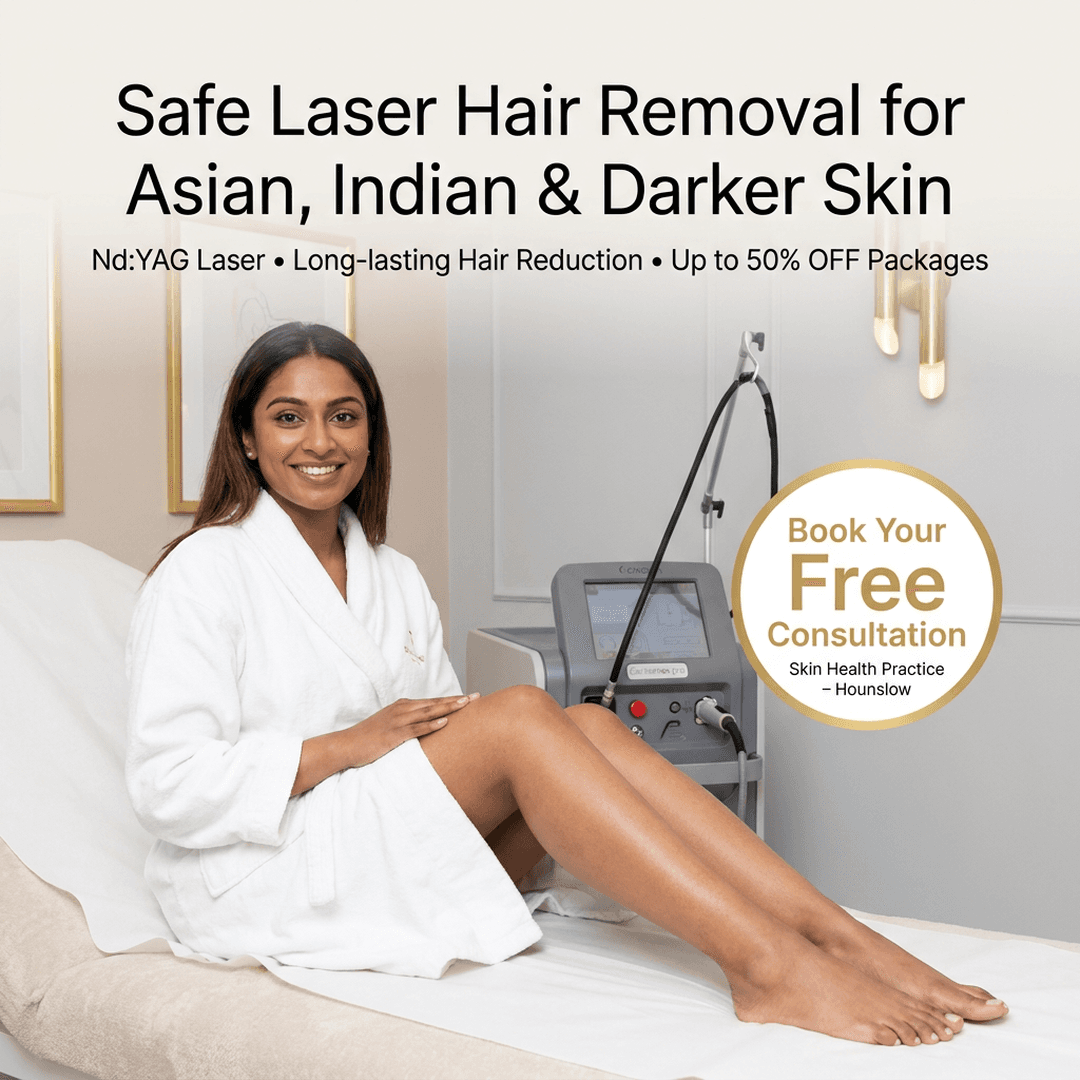
Is laser hair removal safe for dark skin? It can be, when the right laser is used. The Nd:YAG 1064nm laser is absorbed less by the melanin in the skin, so with a patch test, conservative settings and good aftercare, many women with brown and Black skin can be treated with a low risk of burns or dark marks.
If you have been turned away from laser hair removal, or told it is not safe for you, that advice usually reflects the equipment a clinic had rather than your skin. This guide explains why, and what to ask before you book.
Why Some Lasers Are Risky on Darker Skin
Lasers remove hair by targeting melanin, the pigment that gives hair its colour. Shorter-wavelength devices, such as the 755nm Alexandrite laser and IPL, are absorbed very strongly by melanin, and they cannot fully tell the melanin in the hair from the melanin in the surrounding skin. On darker skin the skin itself can absorb too much energy, which can lead to burns, blistering or post-inflammatory hyperpigmentation (dark patches that can take months to fade).
That is why many clinics have historically avoided treating darker skin. The issue was the wrong equipment, not laser hair removal itself.
How the Nd:YAG Laser Is Different
The Nd:YAG laser works at 1064nm, a longer wavelength than other hair removal lasers. Melanin in the surface of the skin absorbs much less of it, while the light still reaches the base of the hair follicle. In practice that means more of the energy goes into the hair and less into the skin around it, which is why the Nd:YAG is the laser generally preferred for melanin-rich skin, including Fitzpatrick types V and VI.
It does not remove all risk. Settings still have to be judged for your skin, and some areas, such as the bikini line and underarms, need extra care because the skin there is often naturally darker.
What Keeps the Risk Low
A patch test comes first. A small area is treated at conservative settings and checked over the following days before any full session. Energy is then increased gradually as your skin shows it tolerates it, and the skin is cooled during each pulse. Sun protection matters just as much: tanned or recently sun-exposed skin is more likely to react, so avoid sun and self-tan during your course and use a broad-spectrum SPF on treated areas. If any darkening appears, tell your practitioner so settings can be adjusted.
What Results to Expect
Laser gives long-term hair reduction, not guaranteed permanent removal, on any skin tone. A full course is usually 6 to 8 sessions for body areas, spaced 4 to 6 weeks apart, and facial hair often needs more. Most clients see a substantial reduction, with regrowth finer and lighter, although results vary from person to person. Coarse, dark hair tends to respond well. Hormonal hair growth, for example with PCOS, may need occasional maintenance.
Which Page Fits Your Skin?
We have a dedicated page for each skin type, covering the laser, the patch test and aftercare in more detail:
Laser hair removal for dark skin, for deep brown and Black skin (Fitzpatrick V and VI).
Laser hair removal for Indian skin, for Indian, Pakistani, Bangladeshi and Sri Lankan skin.
Laser hair removal for Asian skin, for Chinese, Filipino, Vietnamese, Korean and other East and South-East Asian skin.
Book a Consultation in Hounslow
Skin Health Practice is a women-only clinic in Hounslow. We offer a free consultation and patch test before any laser treatment, so you can see how your skin responds before you commit. Read more about laser hair removal in Hounslow, or call 020 3886 1313 to book. We are at 65-73 Staines Road, Hounslow, TW3 3HW.